

Modern vehicles do more than steer, brake, and roll down the road. Many now watch lane markings, monitor following distance, warn of hazards, and in some situations intervene before the driver can react. These advanced driver assistance systems, commonly called ADAS, depend on a precise understanding of where the vehicle is pointed and how its sensors are aimed.
That is why wheel alignment and ADAS calibration are no longer separate conversations. A vehicle can have new tires, a clean windshield, and no warning lights, yet still deliver unreliable assistance if its wheel angles or sensor positions are outside specification. Understanding the connection helps drivers make safer repair decisions and helps shops deliver work that protects both tire life and technology performance.
Why Vehicle Geometry Matters to Modern Driver Assistance
Wheel alignment is the process of measuring and adjusting the angles of the wheels so they match the vehicle manufacturer’s specifications. The primary angles include toe, camber, and caster. Toe describes whether the tires point slightly inward or outward when viewed from above. Camber describes the inward or outward tilt of the tire when viewed from the front. Caster relates to the steering axis angle and affects stability, steering return, and straight-line tracking.
These angles may sound purely mechanical, but they influence the digital systems that interpret the road around the vehicle. ADAS features such as lane keeping assistance, adaptive cruise control, blind spot monitoring, automatic emergency braking, and parking support depend on cameras, radar sensors, ultrasonic sensors, lidar on some models, and steering angle data. If the vehicle is not tracking straight, or if the steering wheel is slightly off-center after an alignment error, the ADAS control modules may receive data that does not match real-world vehicle movement.
For example, a forward-facing camera may correctly identify lane lines, but if the vehicle is dog-tracking because of rear toe misalignment, the system’s calculated centerline can be subtly wrong. A radar sensor may measure distance accurately, but if the thrust angle of the vehicle is incorrect, the system may not be aimed along the actual path of travel. Over time, these small discrepancies can affect how smoothly and reliably driver assistance features behave.
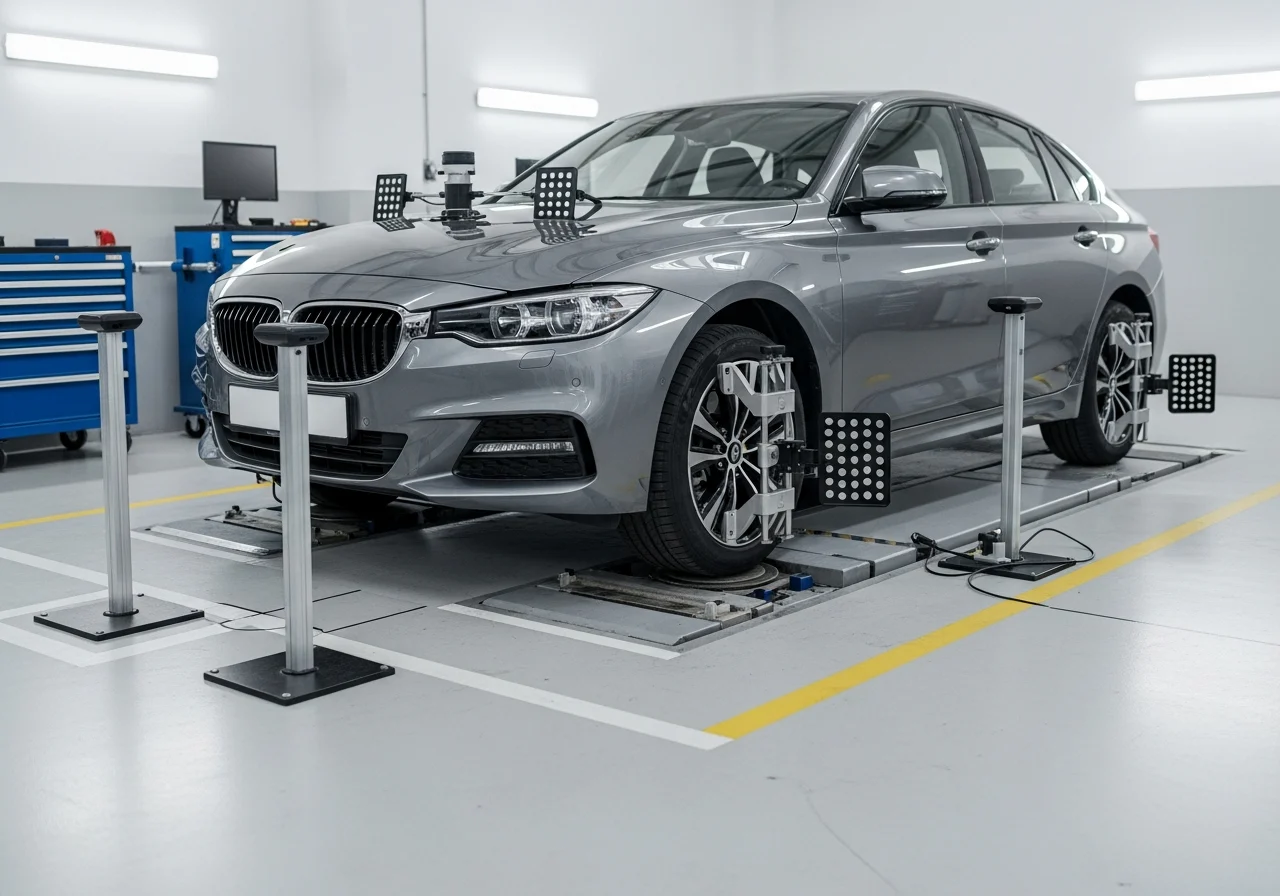
This is the key point: ADAS does not operate in isolation. It uses the physical vehicle as its platform. When the platform is not geometrically correct, even a properly functioning sensor can produce results that are less precise than intended.
How ADAS Sensors Depend on Alignment Accuracy
ADAS sensors are mounted to the body, windshield, grille, bumper, mirrors, or other fixed points. Their software assumes those mounting points relate to the road and the vehicle centerline in a very specific way. A camera is not simply seeing the road. It is seeing from a calculated height, pitch, yaw, and lateral position. Radar is not simply sending out a signal. It is projecting a field in a carefully defined direction. Alignment gives those assumptions a trustworthy foundation.
The connection is especially important with the thrust angle. Thrust angle is the direction the rear wheels are pushing the vehicle compared with the geometric centerline. If the rear wheels point slightly left or right, the driver may compensate by holding the steering wheel at an angle to keep the vehicle traveling straight. That compensation can confuse systems that rely on steering angle, yaw rate, wheel speed, and camera data to determine whether the vehicle is centered in a lane.
Forward cameras and lane support
Forward cameras are typically mounted near the rearview mirror area. They identify lane markings, traffic signs, pedestrians, vehicles, and other objects depending on system design. If the windshield has been replaced, the camera bracket has shifted, the suspension ride height has changed, or the alignment is off, the camera’s view may no longer match the calibration values stored in the vehicle.
Lane departure warning and lane keeping assistance are particularly sensitive because they compare road markings with the vehicle’s projected path. A small alignment deviation can alter how the vehicle moves relative to the lane. The system may warn too early, warn too late, tug at the steering unexpectedly, or fail to assist when the driver expects support.

Radar sensors and distance judgment
Radar sensors are commonly used for adaptive cruise control and forward collision warning. Many front radar units sit behind a grille emblem, lower bumper cover, or dedicated sensor cover. If a radar sensor is aimed even slightly away from specification, it may track the wrong object, misjudge lane position, or reduce system availability.
Imagine a vehicle that has had front suspension repairs after a curb impact. The wheels may be close enough for the vehicle to drive, but if toe or caster is not corrected and the radar is not calibrated as required, the system may interpret traffic ahead from an incorrect reference direction. In dense traffic or on curved roads, precision matters.
When Alignment and Calibration Should Be Performed Together
Alignment and ADAS calibration should be considered together any time work affects the suspension, steering, wheels, tires, ride height, body structure, windshield, bumper, or sensor mounting locations. Many vehicle manufacturers specify calibration after certain repairs even if the dashboard shows no warning light. A warning light is helpful, but it is not a complete diagnostic strategy.
A common scenario is a tire or suspension impact. Hitting a pothole, curb, road debris, or parking barrier can bend components or shift alignment angles. The driver might notice a pull, uneven steering wheel position, or vibration. However, the more subtle risk is that ADAS features may now be working from a compromised vehicle path. An alignment check can reveal the mechanical issue, while calibration confirms that sensors and modules are interpreting the corrected vehicle geometry properly.
Another common scenario is windshield replacement. If the vehicle has a camera mounted to the glass, the replacement windshield must be installed correctly, the camera bracket must be positioned accurately, and calibration may be required. Even a high-quality windshield installation can still require calibration because the camera’s viewing angle must be matched to the vehicle’s control system.

Tire changes can also matter. Replacing tires with the correct size, load rating, and inflation pressure helps maintain proper ride height and rolling circumference. If a vehicle receives tires of a different diameter, or if uneven wear has been allowed to develop, sensors may receive inconsistent wheel speed or vehicle attitude information. Alignment after tire replacement protects the investment in new tires and supports accurate ADAS operation.
Static Calibration, Dynamic Calibration, and Why Conditions Matter
ADAS calibration generally falls into two broad categories: static calibration and dynamic calibration. Static calibration is performed in a controlled shop environment using targets, measurement equipment, scan tools, level floors, and specific distances. Dynamic calibration is performed while driving the vehicle under defined road, speed, lighting, lane marking, and traffic conditions. Some vehicles require one method, some require the other, and some require both.
Static calibration requires strict setup. The vehicle may need to be on a level surface with correct tire pressure, proper fuel level, no excess cargo, and a centered steering wheel. Targets must be positioned at exact distances and angles from the vehicle. If the alignment is not correct before the calibration, the sensor may be calibrated to an incorrect vehicle path. That can make the calibration appear successful while the underlying geometry remains wrong.
Dynamic calibration is equally dependent on preparation. A technician may need to drive on roads with clear lane markings, moderate speeds, good weather, and stable traffic patterns.

The most professional approach is to inspect alignment and vehicle condition before calibration, perform necessary mechanical corrections, then calibrate according to the manufacturer’s procedure. This sequence helps prevent repeated calibrations, customer comebacks, and unsafe assumptions about system performance.
Real-World Symptoms That May Point to an Alignment and ADAS Issue
Not every ADAS concern is caused by wheel alignment, and not every alignment concern affects ADAS in an obvious way. Still, certain
patterns can suggest that the vehicle needs both a mechanical alignment evaluation and an ADAS system check.
Drivers should also pay attention after repairs. If a bumper cover has been removed, a grille has been replaced, suspension parts have been changed, or the windshield has been serviced, ADAS behavior should not be judged only by whether a warning light appears. Manufacturer procedures and reliable diagnostic information matter because many systems can be slightly inaccurate without setting a fault code. Educational resources such as the NHTSA driver assistance technologies guide explain how these features are designed to support, not replace, attentive driving.
What a Proper Service Process Should Include
A quality Alignment & ADAS Services visit should begin with a detailed interview and inspection. The technician should ask about impacts, recent repairs, tire wear, warning messages, windshield work, and changes in system behavior.
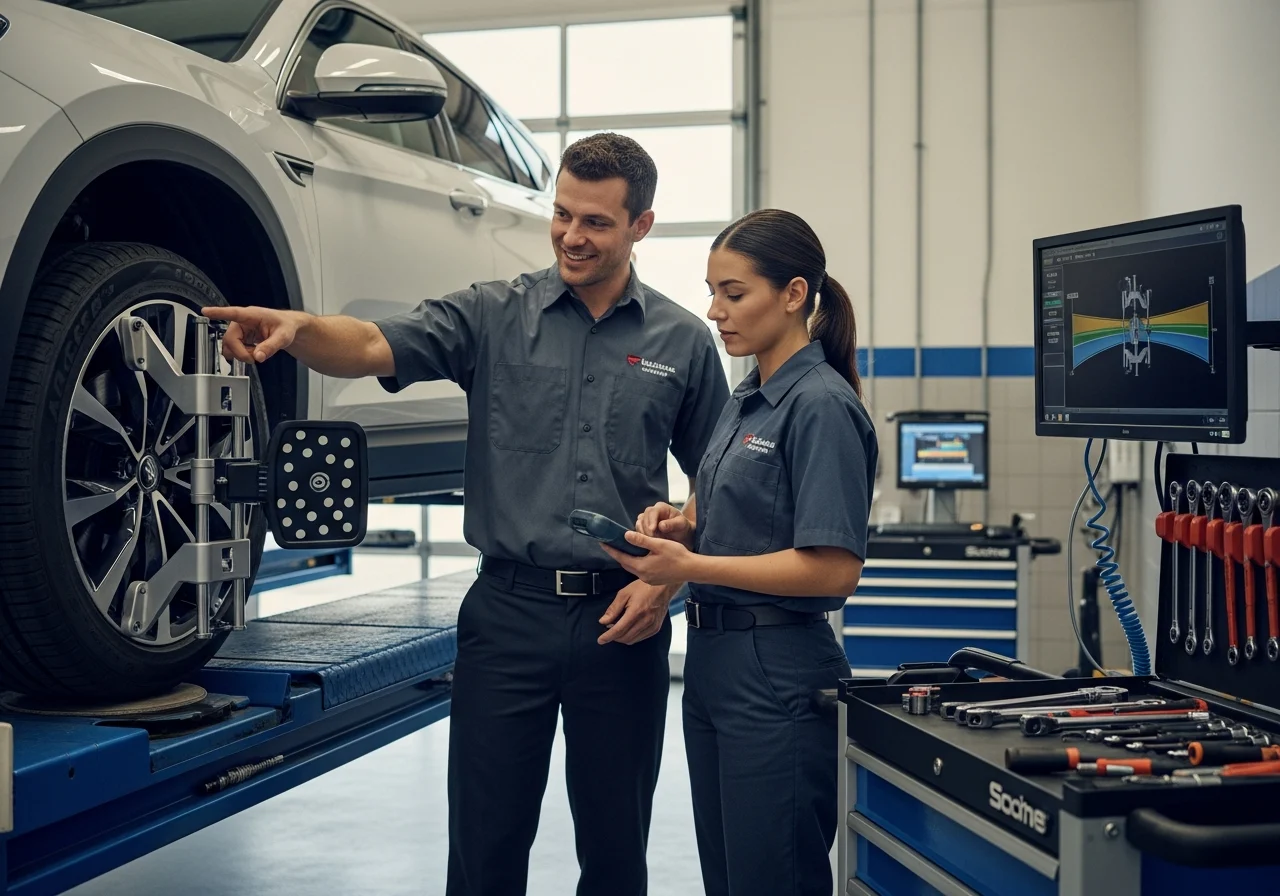
Next, the alignment should be measured with professional equipment and compared with factory specifications. If adjustments are needed, they should be completed before calibration unless the manufacturer procedure specifically says otherwise. Afterward, the technician should use an appropriate scan tool, service information, targets, and road test procedure to complete calibration. The IIHS overview of advanced driver assistance highlights why proper function matters, especially as more crash avoidance features become common on everyday vehicles.
Protecting Safety, Tires, and Technology
Alignment protects tires from premature wear, improves steering feel, supports fuel efficiency, and helps the vehicle track predictably. ADAS calibration protects the accuracy of systems that may warn the driver, apply braking, or provide steering assistance.
Drivers should remember that ADAS features are not a substitute for careful driving. Even correctly calibrated systems have limits related to weather, lighting, road markings, sensor blockage, and traffic conditions. Research from the Federal Highway Administration on lane markings and visibility shows how roadway conditions can affect what camera-based systems and drivers are able to see.
Takeaways
The relationship between vehicle alignment and ADAS calibration is one of the most important changes in modern automotive service. A car is no longer only a mechanical machine, and its safety systems are no longer only electronic accessories.
For the safest outcome, alignment should be checked whenever steering, suspension, tires, body panels, glass, or sensors are repaired or disturbed. Calibration should then be performed when required by the manufacturer, after the vehicle’s physical foundation has been confirmed.
Need help with Ensuring Safety: The Connection Between Vehicle Alignment and ADAS Calibration?